Housing in Mason County
Addressing Mason County’s Housing Needs
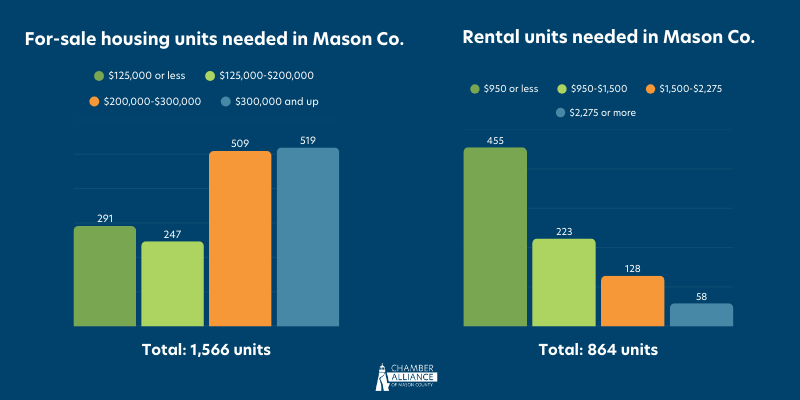
Mason County is facing a shortage of 2,430 housing units over the next five years. To sustain our local businesses, keep families in the community, and provide housing for workers and students, we need solutions at all price points. A stable housing supply is essential for economic growth, vibrant neighborhoods, and a thriving community.
Housing is a complex issue that will take the community – from all vantage points – to come together to solve. The Mason County Housing Alliance serves as a resource for education, advocacy, and collaboration.
Together, we can build a stronger, housing-ready Mason County.
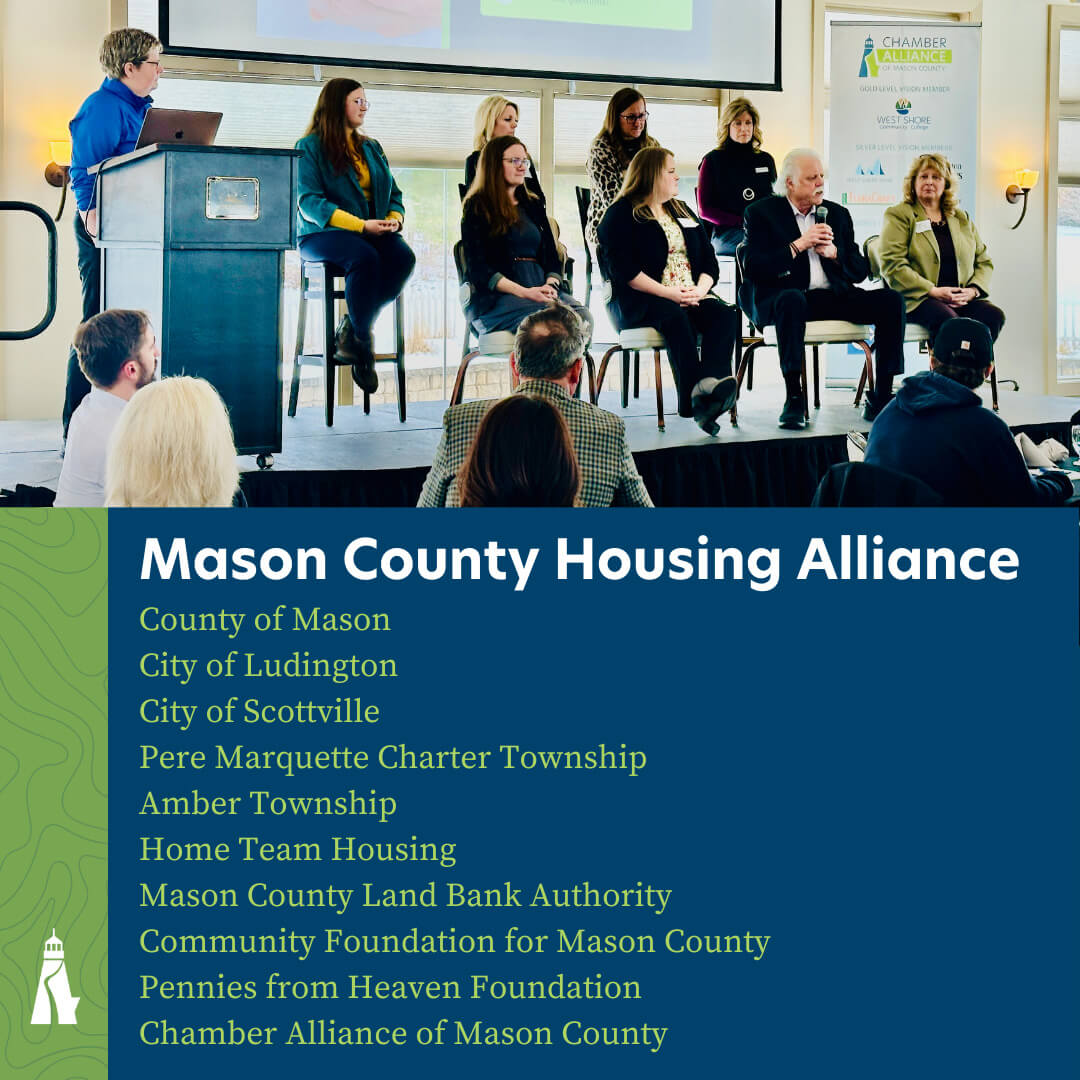
The Mason County Housing Alliance is a collaborative effort led by the Chamber Alliance of Mason County, bringing together municipalities, the business community, and nonprofit organizations. While the alliance is not a standalone entity, it is a dedicated coalition committed to advocating for and educating the community on housing needs.
Communities nationwide are facing housing shortages, and the housing alliance is working together to ensure that Mason County can respond to current housing needs and ready for growth and development. While not alone in this crisis, Mason County’s housing challenges are unique, shaped by a strong second-home market and a tourism-driven economy. However, the housing alliance is committed to taking action to be a housing-ready community.
By Ryan Kilpatrick
If you’ve spent any time talking with neighbors, clients, or candidates for elected office over the past few years, you’ve heard some version of the same complaint: wages just haven’t kept up with the cost of living. It’s become a kind of folk wisdom — repeated so often that it feels self-evidently true.
But is it actually true in Michigan? I pulled twenty years of data to find out, and the answer is more interesting than the conventional narrative suggests.
By Ryan Kilpatrick
Michigan’s housing bills are moving — and the communities that benefit most won’t be the ones who wait for the ink to dry.
The MI Housing Readiness Package would accelerate construction and rehabilitation, require updates to local zoning, and catalyze investments in housing as a talent-retention tool. The bills have bipartisan co-sponsors and real momentum. There will likely still be some changes to the final bills, but more Michiganders are finally understanding just how hard our codes have made it to build anything other than large, single-family homes.
By Ryan Kilpatrick
Walk into any city council meeting, neighborhood association gathering, or community forum about housing, and you'll inevitably hear some variation of the phrase "Why don't they just..." followed by what seems like a perfectly reasonable suggestion. Why don't they just build more affordable housing? Why don't they just keep taxes low? Why don’t they put a grocery store there? Why don’t they just put in light rail? Why don't they just maintain our neighborhood character while solving the housing crisis?
These well-intentioned questions reveal a fundamental disconnect between what communities want and what's mathematically possible within our current systems. The problem isn't that city planners, developers, or elected officials lack creativity or compassion. The problem is that many of our collective expectations exist in contradiction to basic economic and fiscal realities.
By Ryan Kilpatrick
America has a housing problem, but it's not just about quantity—it's about fit.
While headlines focus on housing shortages and affordability crises, there's a fundamental disconnect between the homes we're building and the homes Americans actually need. This mismatch represents one of the most overlooked aspects of our national housing challenge.
The Demographics Don't Lie
The American household has transformed dramatically over recent decades.
By Ryan Kilpatrick
In countless ways, those with economic power today are undermining the potential of future generations. The housing market is perhaps the most tangible example of this generational inequity.
The Numbers Tell the Story
For more than two decades, communities across the United States have consistently underproduced housing relative to the number of new households formed. This isn't just a big-city problem—it's happening everywhere, even in places with stagnant or declining populations.
Consider this stark statistic: In the 1980s, more than 40% of new homes constructed were under 1,400 square feet and designed for first-time homebuyers. Fast forward to 2022, and fewer than 7% of new homes target similar buyers.
Why does this matter? Because household growth isn't strictly tied to population growth. A single family of four living in one home can quickly transform into three separate households when adult children move out to start their own lives.
Full-time employees living in their vehicles. Two families totaling eight, doubled up in a two-bedroom house. The guy living in an unheated garage. Another living in a tent in the woods. The family with small children living in a camper. These are just several housing insecurity situations I encountered when working for United Way of Mason County just a few years ago. All the adults were full-time employees in our community who could not find housing. My job was to assist them. I almost always failed, not for lack of trying, but because there was usually nothing available. By the time I left United Way in 2022, the situation had grown even worse.
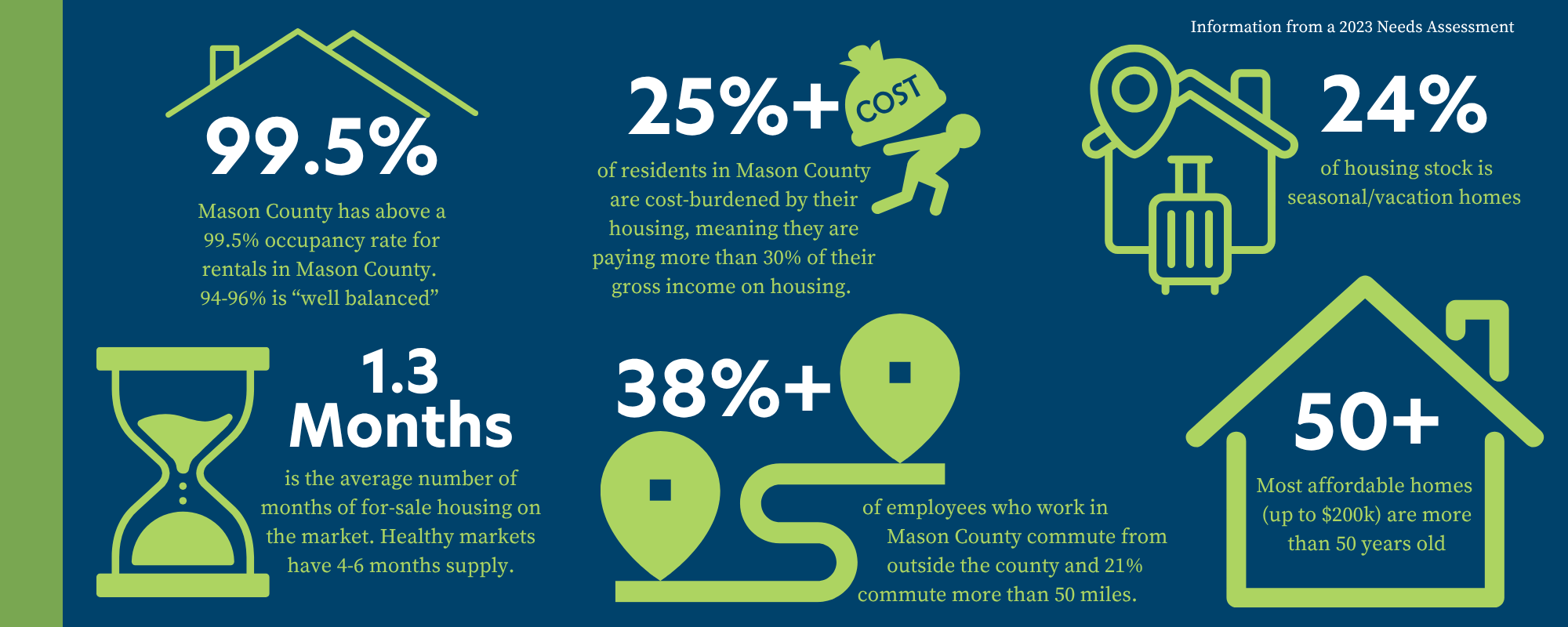
In August 2023, Bowen National Research completed a housing needs assessment for Mason County, which showed that 2,430 more housing units were needed to meet the needs of people currently living and working in the county. The anecdotal evidence I had from my United Way days was confirmed. The study also showed that more than 38% of current employees commute into Mason County to work, many of whom probably do so because it’s almost impossible to find housing here. Additionally, 21% commute more than 50 miles one way! In my new role as Economic Development Director, I question how long some of these employees will continue to commute before they take a job closer to home. Our scarcity of housing is not only a basic needs problem but also an economic development problem, preventing some employers from filling key positions and growing their businesses and organizations.
The Michigan Office of Rural Prosperity has awarded the Chamber Alliance of Mason County a $50,000 Rural Readiness Grant to continue the work of the Mason County Housing Alliance (MCHA), which the Chamber Alliance facilitates.
The MCHA is a group of community leaders working with a consultant to help make Mason County more “housing ready.” This is the second Rural Readiness grant the Chamber has received, awarded in fall 2023 when the grant program was first conceived.
Partners across the county came together in early 2023 to pursue a housing needs assessment to ultimately help guide the community to increase housing in all capacities throughout Mason County. These partners included the Chamber Alliance of Mason County, Mason County, City of Ludington, City of Scottville, Habitat for Humanity of Mason County and Community Foundation for Mason County.
The Housing Needs Assessment, completed by Bowen National Research, provides the data and numbers to support housing as one of our community's most critical needs. The information in the report puts Mason County in a better position to prioritize development needs, and take action in this housing crisis.
Bowen National Research Report
Public presentations of the assessment were given by Patrick Bowen on September 25, 2023. You can view that presentation here.
We have a vision that communities across Mason County will be aligned around a shared understanding of the regional housing needs and solutions. Multi-sector partners will work together to ensure an abundant supply of adequate housing at every price point – serving the workforce, seniors, and year-round residents, both homeowners and renters.
Here is a collection of 12 tools that remove barriers and unlock new resources to create more affordable housing. It will require creativity and, so long as we stay anchored to our values, we can build a new housing landscape that people feel proud to call home while remaining true to our spirit.
There are common misconceptions when it comes to housing in communities. To dispel these misconceptions, we have addressed some of the most common myths here:
How You Can Support and Advocate for This Work
Stay Informed Online
- Follow us on Facebook, and share what you see and learn
- Follow us on LinkedIn
Use Your Social Capital
- Talk about what you have learned about housing and help dispel myths when you hear them
Use Your Political Capital
- Write a letter to your elected official
- Meet 1:1 with public officials and share your story and thoughts about local housing
- Attend public meetings and speak up or submit a letter for the record
Use Your Financial Capital
- Access to available land near neighborhood services and amenities is a key factor in expanding housing options. We encourage you to reach out if you own underutilized property that could support housing development.
- Local housing solutions also thrive with local investment—if you're interested in supporting projects, we can connect you with potential developers aligned with your interests and expectations.